
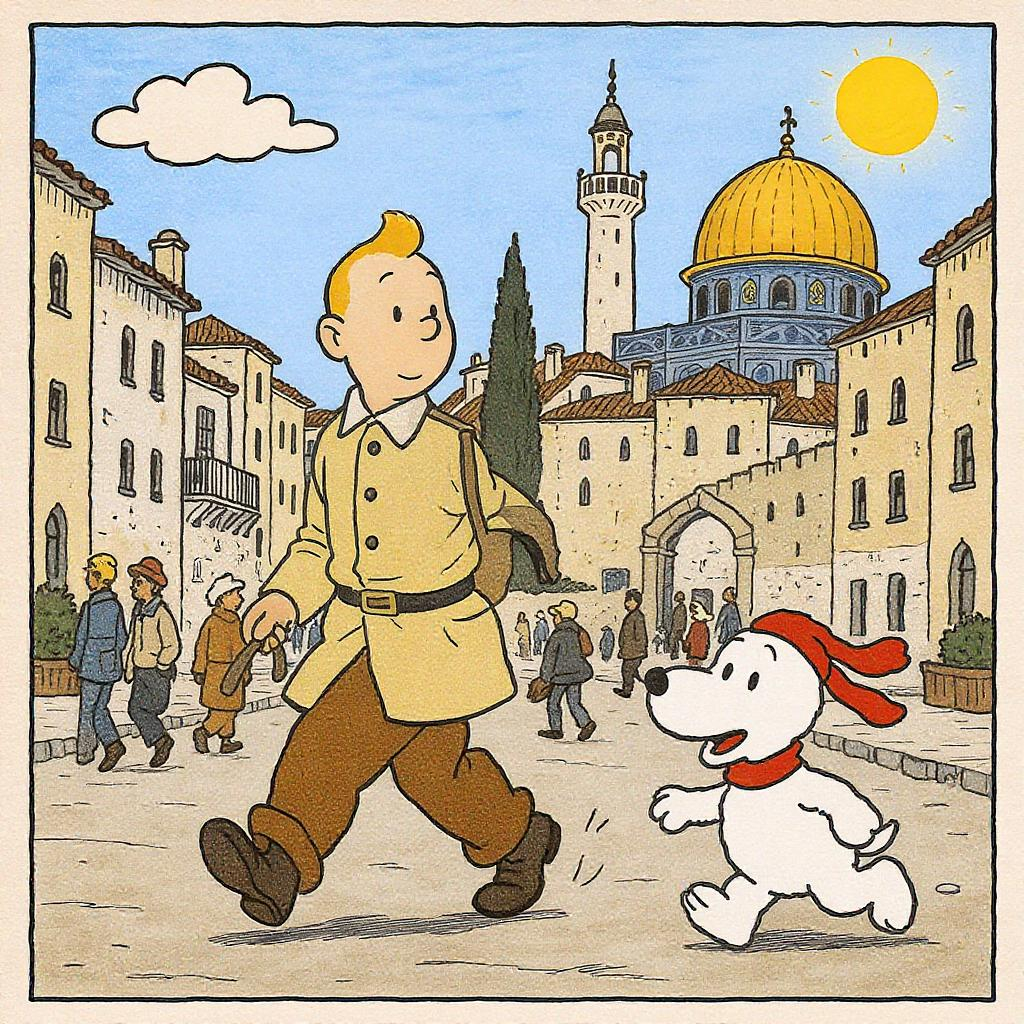
The Adventures of Tintin in Jerusalem

Published Post author

For as long as I can remember, my study wall has been lined—well, virtually lined—with Hergé’s Tintin adventures. From the snows of Tibet to the sands of Egypt, from the markets of Morocco to the frozen shores of Iceland, Tintin and Snowy have taken me everywhere… even to the Moon!

And yet, one place was missing.

“Strange,” I thought one evening, leafing through the albums. “Tintin’s been to the Belgian Congo, the United States, India, China, the Soviet Union… but never Israel!”

The idea stuck in my mind like a burr. What would the world’s most intrepid reporter make of the Holy Land?

I could almost see it—Tintin, standing solemnly at the Western Wall, his brow furrowed in concentration. Snowy, peering up in confusion:
“Why is my master wearing a kippa and tying those leather straps? And… is that a note he’s hiding in the stones? Could he be working for the Mossad?”

Then, in a flash, Tintin in the olive-green of the IDF, Uzi slung over his shoulder, eyes alert for danger. Moments later, the same young man in a Tel Aviv laboratory, tinkering with mysterious devices—exploding beepers, no less!

My imagination was running wild. And then I remembered—thanks to OpenArt, I could bring this vision to life.

So I did.

And though Snowy somehow ended up looking suspiciously like Snoopy (still working on that part!), there they were at last—Tintin and his faithful companion, winding their way through the narrow streets of Jerusalem. An adventure that even Hergé never drew… until now.

—————————————————————————————————————–

Thumbs up:

Zanzibar

Cary

Jason

Joanne

Maurice

Barbara

Richard

Olga

Rissi

Barry

Pablo

Jazz

Kehindo

Erik

Samson

Candace

Lorna

Barbara

Cary

Perry

Share
August 11, 2025

Triggering Memories: A Story about a Survivor and a Stereo

Published Post author

One of the quiet pleasures of blogging is reading the comments from readers. Every now and then, someone writes something so poignant, so unexpected, that it deserves a post of its own.

My friend Jeffrey did just that when he commented on my blog, A Nazi Dagger. His story moved me deeply—and I’d like to share it with you here, in mine and Jeffrey’s words.


Years ago, when I was living in Atlanta, I went to buy my first serious sound system. The store was called High Fidelity SSS—SSS for Sight and Sound Systems. It was owned by a man named Lee Kramer, well known in the area for his classical music show on public radio. He taught listeners about symphonies and sonatas, but also found a way to plug his store during every broadcast.

Naturally, I ended up at Kramer’s, picked out my equipment, and headed to the register.

Lee was behind the counter. He looked me over carefully, eyes scanning me as if they could calculate my credit score on sight.

“Do you have a charge card or a charge plate?” he asked.

“No,” I said, “but I can write you a check.”

At that, his face clouded.

“I don’t know who you are,” he said flatly. “I’ll need to see some additional identification.”

So I pulled out my wallet and began fishing out every bit of ID. I had—driver’s license, Social Security card, voter registration, you name it. I laid them on the counter, one after the other.

That’s when I noticed the tears.

Lee’s hands froze. His eyes welled up. He looked down at the papers and then at me.

“I’m sorry,” he said, voice cracking. “I’m a Holocaust survivor. I escaped from Germany in 1938. When I reached the Swiss border, they stopped me. I didn’t have the right documents.”

I was speechless.

“I begged them,” he continued. “I emptied my pockets, threw down every scrap of paper I had, pleading, ‘Are any of these good enough?’”

He paused, eyes distant.

“And then, the guard looked at me and smiled. He said, ‘Yeah. It’s good enough.’ And he let me in.”

Lee wiped his face, collected himself, and smiled.

“Take it,” he said, pushing the receipt toward me. “Enjoy it. Have a good life.”


Jeffrey closed his comment with these words of wisdom:

“Many incidents in our lives remain with us, hidden deep in our memory banks, just needing a trigger to free them. Whether it’s a Nazi dagger, a Mauser rifle, or just a pile of I.D. papers on a counter. It’s funny how the mind works—and how some things, we never forget.”


Thumbs up:

Effie

Shelley

Joanne

Perry

Sue

Karyl

Jeffrey

Adam

Cary

Laurie

Marianne

Candace, Thanks for sharing

Sampson

Pete

Joe

Paula

Share
August 7, 2025

A Nazi Dagger

Published Post author

File:SS dagger IMG 6806-c.jpg

I’ve been watching Shameless on Showtime, that wild, raunchy comedy-drama about a dysfunctional family on Chicago’s South Side. It’s vulgar, over-the-top, and somehow addictive.

One of the show’s most unforgettable characters is Mickey Milkovich—a small-time hood, gay, volatile, and trapped in the shadow of his father, a tattooed, alcoholic neo-Nazi. The man’s skin is a canvas of swastikas and SS lightning bolts, history’s hate etched in ink.

Spoiler alert: Near the series’ end, Mickey’s father dies—suffocated by a deranged nun, no less. Mickey inherits a cardboard box of horrors: a framed photo of Hitler, an early edition of Mein Kampf, and an SS dagger, its silver blade glinting beneath the imperial eagle and swastika.

In one chilling scene, Mickey lifts the dagger to his face, staring into its reflection as if it holds a secret.
“I wonder how many Jews this dagger has killed,” he mutters.

The line stopped me cold.

Because I have said those very words.

Years ago, I visited my friend Jim at his home in Interlachen, Florida. He’d read my book, A Hebraic Obsession, and knew my fascination with World War II. One afternoon, he opened a closet and drew out a German Mauser rifle—heavy, black, and silent.

“My father was in the Army,” Jim said softly. “He fought in Germany. This was his souvenir of the war.”

I lifted the rifle with both hands. The wood was worn smooth by another man’s grip. The barrel was cold. I checked the chamber—empty. Then I pressed the stock to my shoulder and aimed out the window at a towering cypress tree.

And without thinking, I whispered the same words Mickey spoke:
“I wonder how many Jews this rifle has killed.”
A darker thought followed, uninvited:
“I wonder if any of them were my relatives.”

I handed the rifle back to Jim. He returned it to the closet, closing the door on its dark history.

“Your father must have been a brave man,” I said.

“I always thought so,” Jim replied. “But he never talked about the war.”

We fell silent. And in that quiet, I felt the weight of eighty years pressing down. Even now, the simple touch of a Nazi weapon summons the same haunting question for a Jew:
“How many of my people did this kill?”

I wondered, as I left Jim’s house and as Mickey’s words echoed through my living room, if there will ever come a day when that question no longer needs to be asked—or if history will always whisper from the cold steel of its relics.

——————————————————————————————————————-

Thumbs up:

Sampson

Jason

Howard

Barbara

Seth

Jeffrey

Barry

Joanne

Adam

Shelley

Mervyn

Deborah

Doris

Share
August 5, 2025