The Last Jew in Vinnitsa

Published Post author

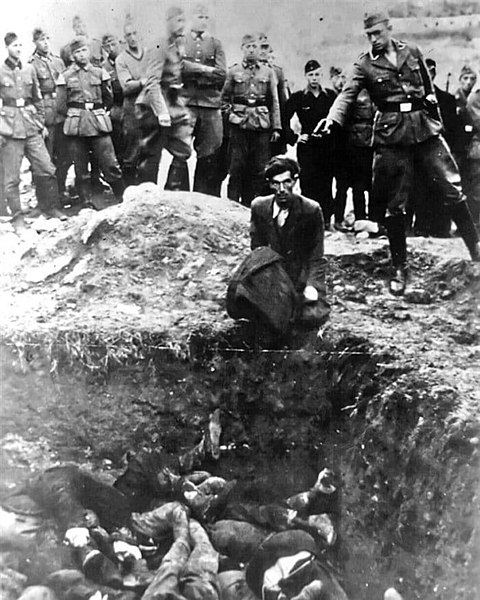
I read an article about Amazon pulling advertisements on its UK site selling T-shirts and other chazerai emblazoned with the photograph of “The Last Jew in Vinnitsa”.

I remember that photo.

I think it’s from Ukraine in 1941 during the “Holocaust of Bullets.”

You remember, the one where of a Jewish man kneels and waits to die.

This iconic image haunts me.

For years I have seen a cropped version of this man-on-his-knees photo.

But today I see it in all of its horror.

He kneels on the edge of a mass grave, a man-made ditch on the perimeter of an airfield where “specialist” SS men had arrived by plane.

Their specialty being shooting men, women and children in the back of the head.

He knows a Waffen-SS officer stands behind him aiming a Walther P38.

He knows his death is imminent.

He knows his death will be quick.

He knows that the force of the bullet will push his body into the pit.

He knows his body will land on the corpses of the men, women and children of Vinnitsa.

The image of their lifeless bodies haunts me.

The murder of Jews shot on film and framed by a professional photographer.

Timed for that split second before death.

Yet haters will deny that it ever happened.

Yet the Jew from the town of Vinnitsa remains stoic and silent—not fearing death.

 “Am I the last living Jew in Vinnitsa?” he wonders.

His mouth tightly shut—not begging, nor praying.

His tearless eyes focus on the German photographer aiming his Leica.

The Leica captures the Jew’s last second.

As the Jew wonders:

“Who and how many people will see this picture?

What type of person would want to see this photograph?

Will my image make a difference in anyone’s life?”

Waiting for the explosion, the Jew ponders, “Why are these bastards photographing their crimes?”

“Will they sell my photo as a souvenir or gift it to their girlfriends or stick it in their family’s photo album?”

His ears still ring from the volley of cracks and bangs emanating from the Walthers.

But he is almost deaf from screams of children.

The eyes refuse to accept what he has just witnessed.

His nightmare will end in a second.

The camera clicks on a man in his thirties, with a full head of black hair, large ears and an unshaven face.

The Leica captures the Jew’s dark coat, white shirt and sunken cheeks.

The Leica also focuses on the tall, lean Schutzstaffel shooter—wearing a field-grey army uniform consisting of: a soldier cap, high black boots, buckled belt, shirt and pants.

The Nazi keeps his mouth tightly shut.

In the background fifteen members of the Einsatzgruppe D, mobile death squad, watch the SS officer point the gun at the Jew’s head. 

Their mouths are tightly shut.

Their emotionless eyes wait for the last Jew in Vinnitsa to meet his fate.

The camera clicks as he falls into the pit.

I reread the article on Amazon pulling ads on its UK site selling T-shirts emblazoned with the photograph of “The Last Jew in Vinnitsa.”

I’m shocked.

I’m angry.

I sit in disgust on the edge of my seat.

My mouth is tightly shut.

But my brain swears that, “The next time someone tells me, “People are tired of all this Holocaust stuff.

 It’s time to move on.

Write about something else.”

I’ll picture the kneeling Jew.

His eyes begging me to write his story.

His eyes praying that I find the right words to silence the forget-about-the-past people.

I want to tell him that, “The Nazis tried to eradicated a religious group that writes, photographs, documents, produces movies and builds museums in honor of their loved ones.”

 I want to tell him that, “They failed and Israel, a Jewish state, exists.

I want to tell him that, “I know the Jews will never stops reminding the world what happened in the Holocaust.”

I want to tell him that, “As the last Jew from Vinnitsa he deserves no less.”

So I say to the requesters of silence, “Buddy, I’ll never get tired of writing about the Holocaust; the Jewish people won’t get tired of telling this horror story for the next six million years.

So why don’t you just keep your mouth tightly shut!

And why don’t you go online and buy a T-shirt that’s emblazoned with a map of Israel and the words, “We’re going to tell the story for the next six million years.”

Note: This story has been referenced in WikiUK, WikiRussia, WikiSpain, WikiIndonesia, WikiGreece
  1. Thumbs up.—Inbar
Share
August 27, 2019

Israel Bonds

Published Post author

Many of my readers ask, “Mort, where do you come up with your ideas for your Times of Israel blog?”

I surprise them with my quick reply, “I follow the linear progression method.”

“What the hell is the linear progression method?”

“Many stories arrive in my head through linear progression—-a process of connecting daily-event dots with straight lines to form the theme of a story.

To put it simply, one thing leads to another.

Here’s an example.

Please listen carefully, I don’t want to have to repeat the process.

A newspaper publishes my story, ‘Planting the Seeds in Your Jewish Heritage Garden’.

In that story, I mention Israel Bonds as one of the seeds in my Jewish heritage.”

I pause to recall my Israel Bond experience.

Remembering buying, giving and getting Israel bonds as bar/bat mitzvah gifts.

Remembering as a 13-year-old:

How rich I felt holding the bonds and

Adding together their monetary denominations;

Touching their textured high quality paper

and examining the beautifully drawn and colored menorah centered on the top of each bond.

Remembering how emotionally invested I felt reading the bold print “The Development Corporation For Israel”.

My money is developing a Jewish homeland.

Here I was a 13-year-old schmendrick, living in a country town in the Catskill Mountains, transforming a country located on the other side of the world.

It doesn’t get much better than that.”

Enough diversion, let’s get back on the linear progression track.

So lo and behold, Liron, a representative of Israel Bonds, emails me a request for a pow wow.

She says, “Here’s a chance for us to discuss our mutual interests.”

I prepare for the meeting by reading Wiki on Israel Bonds.

Nothing better than walking into a meeting mit a bissel knowledge under your belt.

I learn Ben-Gurion conceived the idea to float the bonds in 1950.

As a newly created state, that had just fought a war for its independence, Israel desperately needed funds for immigrant absorption and for the construction of a national infrastructure.

The bond drives were a huge success.

So I meet with the Liron at Starbucks.

We talk, we schmooze and I learn about Israel Bonds.

One story catches my attention.

It’s a story about what happened to Cuban Jews that fled the Communist island in the early Sixties.

Castro did not allow these Jews—or anyone else—to leave the Island with their valuables.

Liron opens and shows me the palms of her hands and then points to her feet,

 “Years earlier, some of these Cuban Jews had bought Israel Bonds.

They knew they could not take their bonds with them.

So they wrote the bond identification numbers on the soles of their feet or on the palms of their hands.

 In Miami, they presented themselves to the Israel Bond officials, they presented their ID numbers and received their funds.

Those funds helped them establish a new life in the States.”

 “What ingenuity! What chutzpah,” I exclaim.

Then I add, “Under these tumultuous times, that’s one hell of an important lesson for all of us to learn.

 Liron, I’m going to write a blog on those Cuban Jews.”

“Mort, I can introduce you to some of the people that wrote those numbers on their hands and feet?”

“Thanks Liron, I’m going to take you up on that offer; I’m going to buy some more Israel bonds.”

Share
August 3, 2019

Sitting Shiva

Published Post author

My Dad (second row center) in Slave Labor Before Death Camps

Three days after my dad’s death, I sat Shiva in my mother’s Boca Raton home.

In her villa, a group of ten men—our minyan—stood, talked and waited for the Rabbi to make his appearance.

Alone, I stared out the kitchen’s glass doors at the lake and the golf course.

I flashed back at how happy my father was when Jason, his grandson, caught a large bass in that lake.

I smiled realizing that picture had become one of my inerasable Kodak moments.

Each day of Shiva, in this kitchen, I sipped flavorless coffee, as my reddened eyes noticed that the lake appeared a paler shade of blue and the golf course a browner shade of green.

In this kitchen, I recalled the sweet taste and rich aroma of my dad’s freshly-brewed coffee.

How it ran over my tongue and ignited my taste buds.

And how in this kitchen, I admired him.

Walking into the living room, I found myself surrounded by acquaintances, family and unknown friends of my parents.

My father touched all their lives.

They shook my hand, expressed their condolences and said how much they respected my dad.

These living room walls were lined with impressionist paintings.

Like these paintings, I now lived in the shadows of a blurred life.

In this living room, on these couches, next to these paintings, my dad and I talked for hours.

He was a master storyteller—a male Scheherazade.

We discussed wars, history, and how life was treating us.

He told off-color jokes and I laughed.

I loved his sense of humor and he knew it.

Those days and those laughs were now gone forever.

The rabbi’s appearance broke my daydream.

He instructed the minyan to stand and face east.

He led us in prayer.

He helped my mom, my sister and I recite the Mourner’s Kaddish.

As the three of us searched for meaning and comfort in this ritual, I silently prayed, G-d walk through our house and take away our sorrow and please watch over us and heal my family.

After the Rabbi left the villa, two elderly men cornered me in the vestibule.

“Hi, I’m Saul and this is David. It is our pleasure to meet you.”

They appeared to be in their late sixties or early seventies…short, balding men with protruding stomachs.

They both wore white cotton short-sleeve shirts and like my father, bore tattooed numbers on their forearms.

I shook their hands and glanced into their eyes.

I sensed they were messengers, sent to tell me a story, sent to hand me another piece to the puzzle that made up my father’s life.

In a thick Polish accent, Saul said, “You know you look an awful lot like your father.”

“Thanks,” I replied. “Many folks considered him a handsome man.”

David piped in, “Many women loved the way he looked and dressed. He told us many stories about the time he spent in Rome before the war, when he was in medical school, about those beautiful Italian women he knew. Boy could he tell a story—so descriptive, down to the minutest detail.”

Saul interrupted, “Your father befriended us during the last days of the war… in the death camp, just days before we were all liberated by the Soviet Army.”

“We wanted to tell you that he saved our lives.” David continued as he rubbed his tattoo.

I remembered hearing those words before. Usually from my father’s patients or their family members who told me how he pulled them away from death and back to the living.

“Thanks for telling me. How did he do it?” I inquired as I pulled on the small piece of black cloth pinned to my jacket.

“He gave us the most important gift of all… the will to live,” Saul said.

David continued, “Well, it was near the end of the war. We were all imprisoned in a concentration camp… inches away from death.

We were ill and starving.

We were skin on bones.

Bombs exploded in the distance, but we didn’t know how many days it would be before the Russian Army liberated us.

Every minute, prisoners died all around us.

Both of us were sixteen years old, and your father knew we were virgins.

He kept telling us, “Keep struggling, don’t give up.”

Your father exclaimed,”Boys, stay alive, you have to make love to a women!”

He told us one story after another about his sexual escapades.”

As David talked, my mind wandered:

“Did my dad know that by telling these stories, to these boys, he was also saving his own life?

Was storytelling his salvation, his medicine of hope and love?

Would I exist if not for those stories?”

Tears formed in David’s eyes as he whispered, “He kept our minds off of food and death. He gave us hope in our darkest moment.  Your father, without medicines, used the only tool left in his medical bag…his brain.”

Saul jumped in, “A brilliant strategy. It worked! We fought death and we won.

I doubt that without those stories we would be talking to you today.”

Hugging both of them, I replied, “Thanks so much for telling me that story. My dad never did.”

Alone I stared out the kitchen window feeling proud of my dad.

I now noticed the brilliance of the lake’s blue waters and the sharpness of the green radiating off the golf course.

Share
July 23, 2019